

Although it doesn’t seem like the obvious reason for your high energy bills, your poorly insulated walls could be the one of the main sources of heat loss in your property. Did you know that approximately 35% of heat loss occurs from the walls?
The best ways to combat your high energy bills is by investing in insulation in the long run. This will make your property more energy efficient and means that you will not have to spend as much money on insulating your property when the heat is being wasted anyway.
If you receive a low income or are on benefits, you could be entitled to a Government Grant which could fund your heating and insulation by up to 100%. Click here to read more about Government Grants and the ECO scheme or click here to apply for a Government Grant.
External Wall Insulation- What is it and how much money could I save?
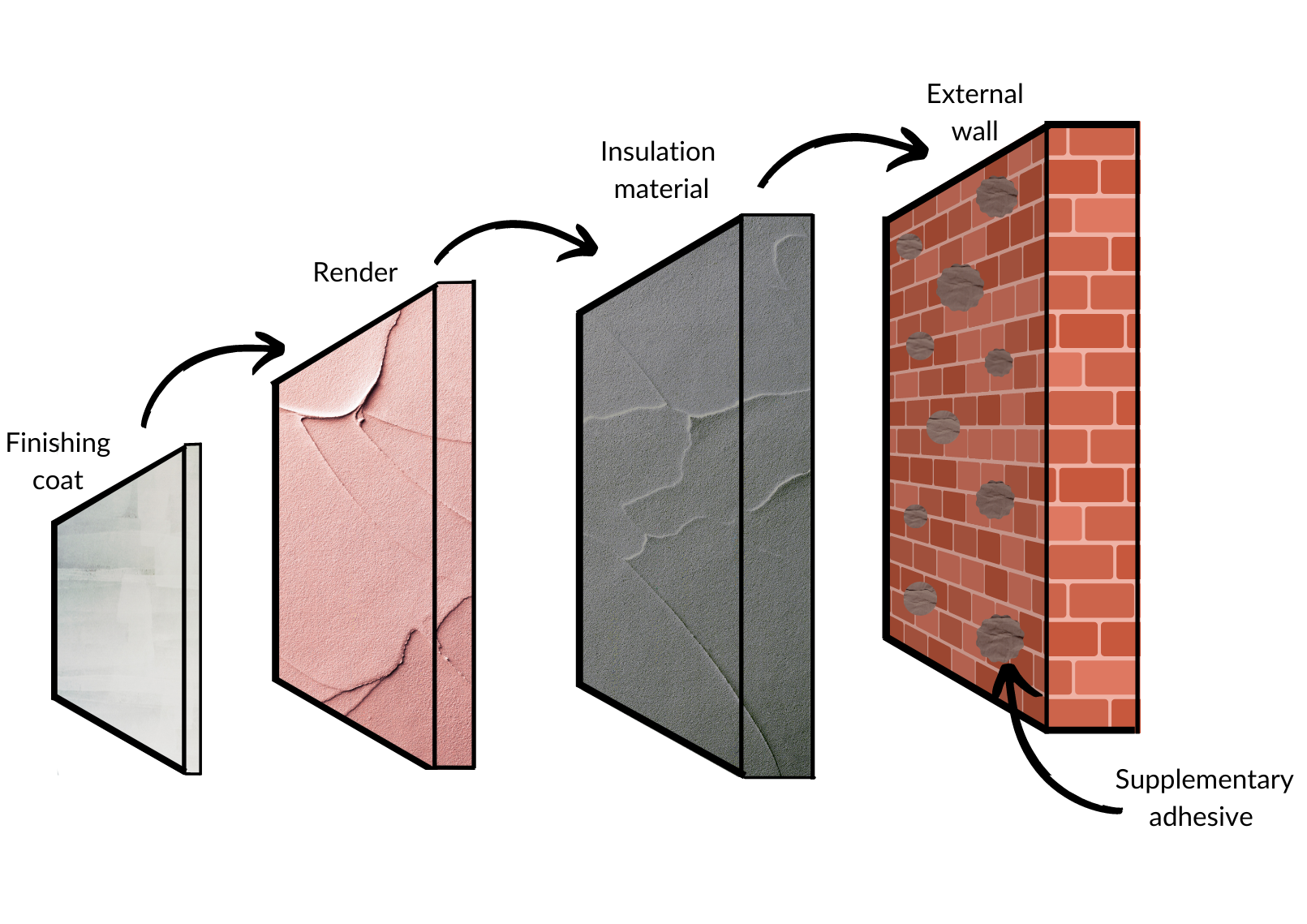
External Wall Insulation is where insulation is fixed to the outside of a property. This will be coated with render or with an alternative cladding to protect it from the elements. This method is often required for insulating walls on solid wall properties where there’s no option for Cavity Wall Insulation.
Whatever else external wall insulation does, it will change the external appearance of the house. In most cases that will mean gaining planning permission before undertaking the work, so do check with your local authority from the outset. Because the insulating process involves covering the original brickwork, the process can significantly alter the appearance of the property.
The insulation process should take three to six weeks unless any structural work needs to take place. The survey that gets completed before the installation will identify whether any structural work will need to take place. If the work is delayed due to reasons such as bad weather, the scaffolding will stay in place for a bit longer and until the work is complete.
Internal Wall Insulation- What is this and how could it reduce heat loss in my property?
IWI is where board and a coat of plaster is applied to the inside of a building. It is used to insulate solid wall properties and it creates a thermal barrier between the inside of your home and the temperature of the outside of your property. It is normally a cheaper alternative to external wall insulation and is ideal for properties where outside insulation is not suitable – such as sandstone buildings. The installation can also be done room by room.
Internal Wall Insulation comes with a 25 year warranty and can save the homeowner/ tenant up to 35% on their heating bills. Here at RMS Energy Solutions Ltd, we only use the best products installed by our highly skilled and fully qualified installers. All off our work is insured and we hold all of the accreditations necessary to carry out these installs to the highest standard.
Unlike external wall insulation, internal wall insulation does not impact a property’s exterior. This work can also be done room by room minimising any disruption. With interior wall insulation, you can create climate zones within a building for more efficient heating or cooling.
Heat naturally moves from a warm space into a cooler area. This means that any heat you generate in your home will try and escape through the walls, floor and roof and transfer outside. Wrapping your home in this protective coating will help to slow or even stop this heat transfer entirely. The warmth will then be retained inside.
Only 8% of the UK’s 8.5 million solid walled homes have any wall insulation. Many of these homes were constructed at a time when energy efficiency wasn’t a consideration. This makes them inefficient and costly to heat.
IWI applications are usually accomplished by stripping back walls and fitting rigid insulation boards. This means that the heat from this insulation is retained in the room rather than being stored in the walls.

Cavity Wall Insulation- How much can installing Cavity Wall Insulation reduce my energy bills?
Cavity wall insulation is where an insulation material fills the air space between the inner and outer wall of your property to stop heat loss from the walls so that your property maintains it’s warmth for longer.
The Cavity Insulation bead is pumped into the wall from the outside of your property through 22mm drilled holes which are later filled with mortar, colour matched to best suit your existing mortar colour.
Here at RMS Energy, our CWI comes with the manufacturer’s 25 year warranty. We empower millions of households each year to make better energy choices. Our dedicated team of expert installers are dedicated to making change happen.
A cavity wall is made up of two walls with a gap in between which is called the cavity. The outer layer is made of brick and the inner layer is made of brick or concrete block. The insulation material that the cavity is filled with is usually mineral wool or beads. (Here at RMS Energy, we use superbead.) The raw bead material used to insulate walls is pellets of plastic which are the size of grains of sand. They contain a gas which expands when it is heated and this makes the pellets increase in size by up to 50 times. The end products are made of up to 98% air. The bead product that we use here at RMS to fill the walls is fire resistant and waterproof.
The installation process is fast and clean. All of the equipment we use is brought and taken away by the installers in just a few hours. The holes that are drilled in the outside walls are sealed with cement afterwards. Once the insulation is complete, the installers fill the holes in the brickwork with colour matched mortar so they will barely even be noticeable.
What is Cavity Wall Extraction and will this need to be carried out first?
To work out which type of walls you have, you can usually identify this by looking at the pattern on the bricks. If your home has cavity walls, the bricks will usually have an even pattern and the bricks have been laid lengthways. If you have solid walls, the bricks will have an alternating pattern. For example, there may be a row of smaller bricks underneath a row of larger bricks. You can also tell which type of wall you have by measuring it’s thickness. This is especially useful if the bricks have been covered. If a brick is more than 260mm thick, it is most likely a cavity wall.
A survey is first carried out to assess whether Cavity Wall Extraction is necessary in the first place before the Cavity Wall can be installed. Cavity Wall Extraction is where the old insulation material is removed to make space for more energy efficient insulation.
An insulation removal system is used to collect all of the cavity from inside the wall and acts like a giant vacuum. This process is called Cavity Wall Extraction. The air pressure is used to suck up the insulation on a large scale.
After the Cavity Wall Extraction has taken place (if that process is necessary), the Cavity Wall can start to be insulated. The insulation material is blown into the wall from the outside of your property through holes that have been drilled in the walls. The holes are then filled afterwards to match your brickwork.

How can I get my insulation funded through a Government Grant?
You can get your wall insulation up to 100% fully funded through a Government Grant.
If you’re interested in applying for a Government Grant, you can click the link here to apply.
After you’ve filled out the form, we will let you know if you’re eligible. We will get in touch with you shortly after that.
But how will you know if you’re eligible for a Government Grant?
The main factors are whether you are in receipt of any benefits and whether you earn a low household income.
These are some of the benefits that mean you could be entitled to a Government Grant:
- Universal Credit
- Income- related and Employment Support Allowance (ESA)
- Child Benefit
- Pension Guarantee Credit
- Job Seeker’s Allowance
- Working Tax Credit
- Carer’s Allowance
- Personal Independence Payment (PIP)
- Severe Disability Allowance
- Child Tax Credit
- Disability Living Allowance (ESA)
- Armed Forces Independence Payment